Inclusive Leadership and Governance

Lead with care and accountability, practise participatory governance, and create the conditions for shared decision-making, deeper inclusion, and responsible leadership.
Start LearningWHAT OUR COURSES OFFER
-
The Practice of Inclusive Leadership
-
What Inclusive Leadership Looks Like
- Defining Inclusive Leadership in Practice
- Core Principles of Inclusive Leadership
- VIDEO: What Makes Leadership Inclusive?
- Leadership Under Pressure
- Judgement Calls in Inclusive Leadership
- My Leadership Signals Audit
- From Intent to Practice
-
Leading with Values and Integrity
- Values-Led Leadership Under Pressure
- Values, Ethics, and Leadership Judgement
- When Organisational Demands Clash with Leadership Values
- VIDEO: Integrity in Everyday Leadership
- Values in Action Decision Map
- My Non-Negotiables as a Leader
- Integrity as a Leadership Practice
-
Inclusive Communication and Presence
- Communication as a Leadership Tool
- Communicating with Clarity, Respect, and Authority
- VIDEO: How Leaders Build Trust Through Communication
- Listening, Presence, and Relational Leadership
- Rewriting a Leadership Message
- Listening for What Is Not Being Said
- Presence, Communication, and Trust
-
Decision-Making in Diverse Environments
- Inclusive Decision-Making in Practice
- Better Decisions Through Wider Participation
- Bias, Assumptions, and Decision Quality
- Who Shapes the Decision?
- Stakeholder Mapping for a Leadership Decision
- Assumption Checkpoint
- Fair Process, Better Leadership
-
Reflective Leadership in Action
- Reflection as a Core Leadership Discipline
- Reflective Practice, Learning, and Leadership Growth
- Feedback, Accountability, and Continuous Improvement
- Why Reflection Matters for Leaders
- Leadership Reflection Journal Prompt Set
- Feedback to Action Plan
- Inclusive Leadership as an Ongoing Practice
-
-
Governance for Equity and Accountability
-
What Inclusive Governance Means
- Understanding Inclusive Governance
- From Oversight to Stewardship: The Role of Governance
- What Makes Governance Inclusive?
- Governance Beyond Compliance
- Governance in My Context
- Stewardship or Control?
- Inclusive Governance as Practice
-
Roles, Responsibilities, and Authority
- Clarity, Authority, and Accountability
- Governance Roles: Board, Executive, and Beyond
- Decision Rights and Inclusive Authority
- Who Decides What?
- Mapping Governance Roles
- Authority Under Pressure
- Clear Roles, Stronger Governance
-
Equity in Oversight and Risk
- Governing Risk with Equity in Mind
- Risk, Harm, and Responsibility in Governance
- Equity in Compliance, Safeguarding, and Financial Oversight
- What Counts as Risk?
- Reframing a Risk Register
- Oversight with an Equity Lens
- Responsible Oversight, Fairer Outcomes
-
Transparency, Challenge, and Scrutiny
- Why Challenge Matters in Governance
- Constructive Challenge and Good Governance
- Transparency, Trust, and Organisational Credibility
- Challenge Without Defensiveness
- Asking Better Governance Questions
- Transparency Stress Test
- Scrutiny as a Form of Care
-
Ethical Governance in Practice
- Ethics in Real Governance Situations
- Ethical Dilemmas in Leadership and Governance
- Integrity, Conflict of Interest, and Responsible Decision-Making
- Ethics When There Is No Easy Answer
- Working Through an Ethical Dilemma
- My Ethical Decision Framework
- Ethics as Daily Governance Practice
-
-
Governing with Stakeholders, Communities, and Partners
-
Stakeholder-Centred Leadership
- Leading with Stakeholders in Mind
- Who Counts? Stakeholders, Power, and Responsibility
- Designing Leadership Around Impact and Accountability
- Seeing the Wider Circle
- Stakeholder Mapping in Practice
- Who Is Missing?
- Leadership Beyond the Organisation
-
Participation Beyond Consultation
- From Consultation to Participation
- The Limits of Consultation
- Designing Meaningful Participation
- What Meaningful Participation Looks Like
- Participation Spectrum Review
- Redesigning an Engagement Process
- Participation with Purpose
-
Accountability to Communities and End Users
- Accountability in Relationship
- What Community Accountability Requires
- Listening, Responsiveness, and Trust
- Accountability to the People You Serve
- Accountability Pathway Mapping
- Designing a Feedback-to-Action Loop
- Accountability That Can Be Felt
-
Inclusion in Partnership and Collaboration
- Governing Across Boundaries
- Collaboration, Power, and Shared Purpose
- Inclusive Partnership Design
- What Makes Partnerships Inclusive?
- Partnership Dynamics Review
- Building a Better Partnership Agreement
- Collaboration with Integrity
-
Legitimacy, Trust, and Public Confidence
- Why Legitimacy Matters
- Trust, Reputation, and Institutional Legitimacy
- Leading Through Scrutiny and Change
- How Trust Is Earned
- Legitimacy Checkpoint
- Trust Repair Scenario
- Governance That Deserves Trust
-
-
Strategy Through an Inclusion Lens
-
Strategy Through an Inclusion Lens
- Making Inclusion Strategic
- Strategy, Priority Setting, and Inclusion
- Resource Allocation, Trade-Offs, and Equity
- Inclusion as a Strategic Choice
- Strategy Review Through an Inclusion Lens
- Priorities and Trade-Offs Reflection
- Strategy as a Governance Choice
-
Governing Change and Transformation
- Leading Change with Accountability
- Why Change Efforts Succeed or Fail
- Governance During Transformation
- he Leadership Work of Change
- Change Readiness Review
- Change Communication Planning
- Change That Holds Trust
-
Building Fair and Credible Systems
- Systems That Support Inclusion
- Policy, Process, and Organisational Credibility
- Designing for Consistency and Accountability
- Fairness Needs Structure
- Process Fairness Audit
- From Principle to System
- Making Inclusion Durable
-
Measuring Inclusion and Governance Effectiveness
- What Should We Measure?
- Measuring Inclusion Beyond Numbers Alone
- Indicators for Governance, Accountability, and Trust
- Measuring What Matters
- Indicator Design Workshop
- Interpreting the Story Behind the Data
- Evidence for Learning and Accountability
-
Sustaining Leadership Beyond Individuals
- Leadership That Lasts
- Succession, Continuity, and Institutional Memory
- Distributed Leadership and Shared Ownership
- Beyond the Individual Leader
- Succession Risk Reflection
- Shared Ownership Mapping
- Embedding Practice for the Long Term
-
WHO THIS COURSE IS FOR
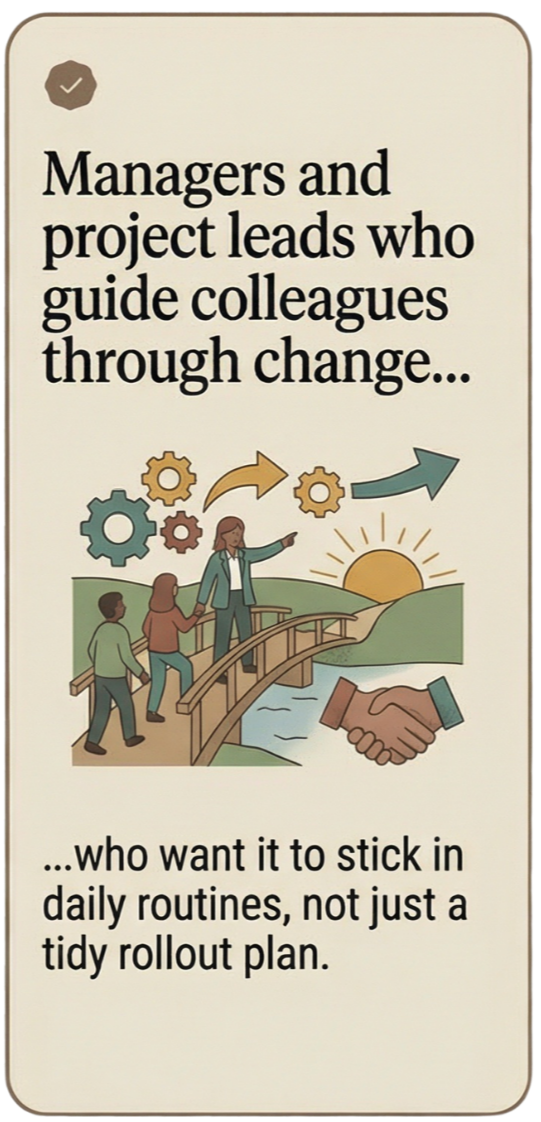
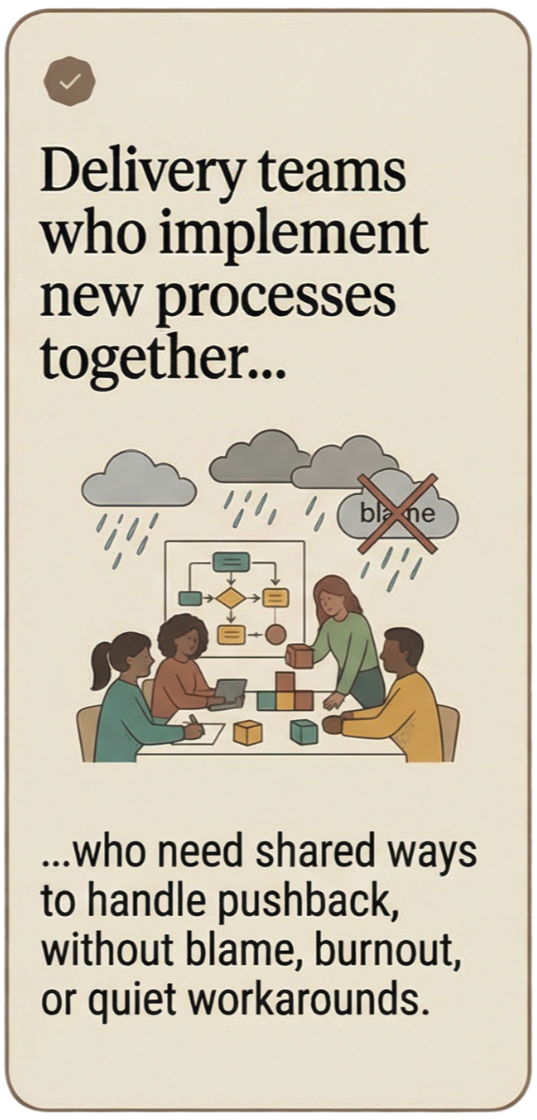

MODULE OVERVIEW

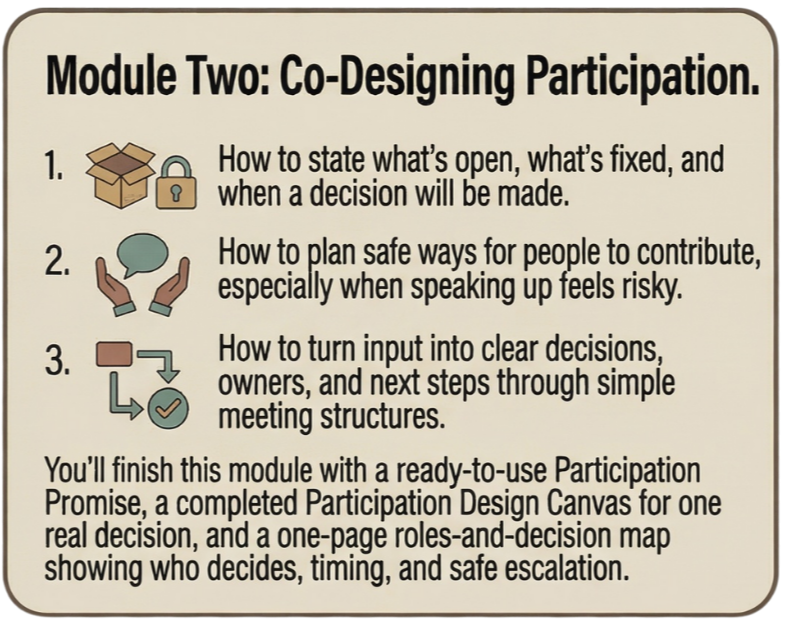
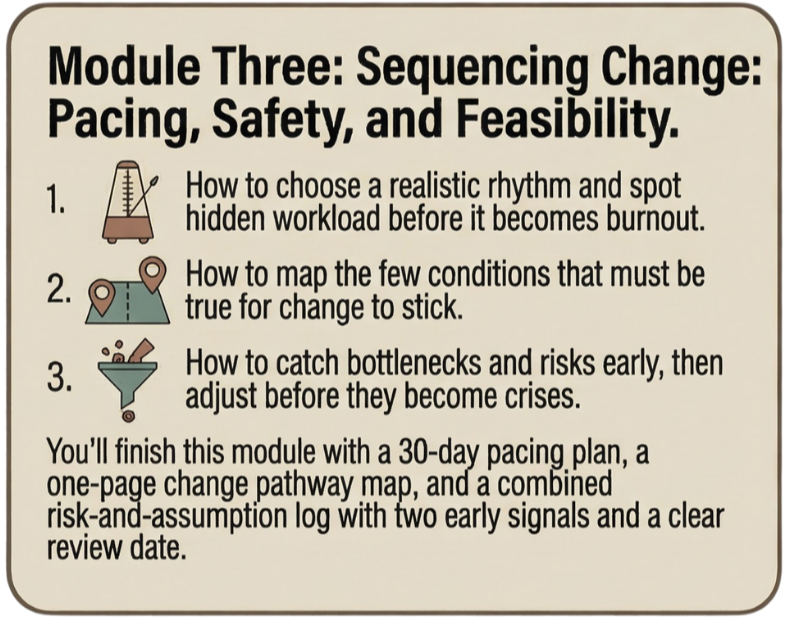
WHAT YOU WILL GAIN